

Programmable banking is the next era of banking.
AI agents and software programs are creating new opportunities and risks for every bank and credit union. The banks that adapt will own the decade ahead.
What is programmable banking?
The business and retail customers of financial institutions are now using AI, ChatGPT, Claude, Copilot or an assistant built into their own software to get their work done. Programmable banking enables a financial institution to connect directly into that environment, so their customers can bank using those tools, instead of switching over to a portal built only for humans.
Programmable banking protects a financial institution's brand and controls.The customer is banking through a different interface, but every dollar still moves safely through the institution's own systems, under its own rules.
Programmable banking also brings net-new capabilities. It identifies the intent behind customer actions, distinguishes AI-driven activity from fraud, and protects both financial institutions and their clients by keeping a ‘human in the loop’ before transactions are executed.
Programmable banking puts your customer in control of the key interface.
For two centuries, a bank has controlled how its clients interact with their own money. That assumption is being dismantled in real time. Your clients now have access to tools powerful enough to build their own financial interfaces, automate their own workflows, and connect to their accounts on their own terms.
In the programmable banking era, your institution provides a secure, compliant connection point. Your client decides how to interact with it, through an app, an AI assistant, or a workflow they've built themselves.
Banking is changing faster than anytime in its history.
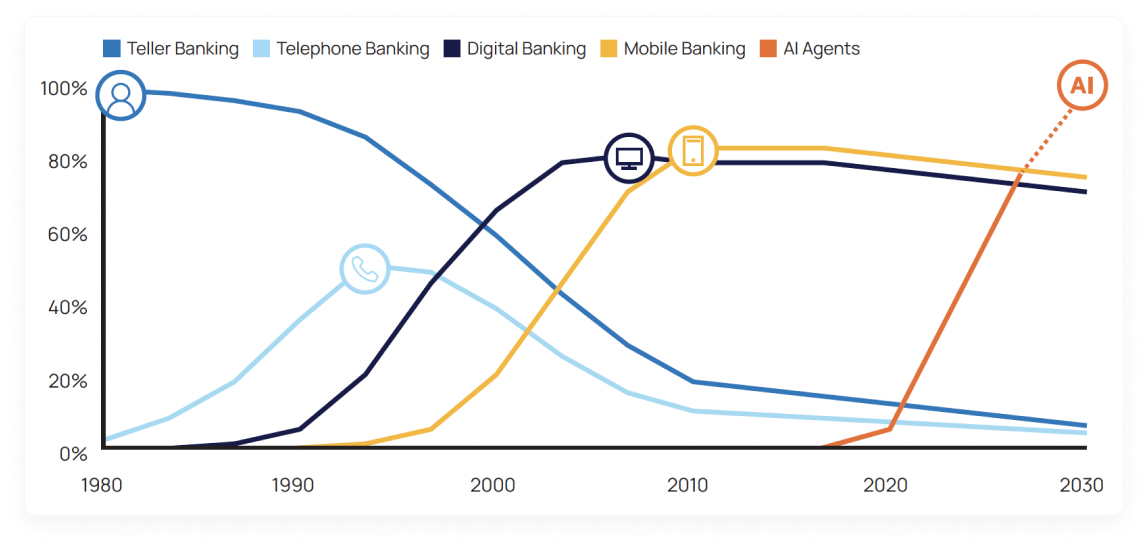
Every prior shift in banking, from tellers to phones to digital to mobile, took a decade or more to fully take hold. AI is moving faster than any of them.


Paywhere: The only banking platform built for the world AI is creating.
1 - Paywhere helps banks grow deposits and keep their clients.
The programmable banking era is creating a new competitive divide. FIs that can serve clients programmatically will deepen those relationships and grow their deposit bases. Institutions that cannot will lose to competitors that can. With Paywhere, banks and credit unions can protect their customer relationships and grow their businesses.
2 - Compliance and safety are the architecture, not an afterthought.
As AI agents begin automating financial workflows, legacy risk systems cannot tell the difference between a misbehaving AI agent and a bad actor. Most platforms were not built for this reality. Paywhere was. The compliance and risk architecture is designed for the speed, volume, and complexity that AI-driven banking demands.
3 - Founded at the convergence of fiat, programmable money, and AI.
Most platforms were built for fiat or digital assets. Paywhere was founded at the intersection of both in the AI age. Stablecoin was in the founding conversation. The Paywhere platform handles both fiat and programmable money rails natively. No retrofitting required.
About Programmable Banking
-
Programmable banking allows businesses to interact with their financial institution using code rather than human-operated portals. It shifts financial services from manual processes to automated workflows. Companies use application programming interfaces (APIs) to connect their internal software directly to banking infrastructure. This direct connection enables real-time account reconciliation, dynamic cash management, and automated 24/7 settlement.
A major advancement within programmable banking is the rise of stablecoin transactions, which are increasingly recognized as a modern evolution of wire or correspondent banking. Stablecoins enable instant, borderless payments, fulfilling the growing industry demand for 24/7 settlement of both domestic and cross-border transactions. This innovation is especially valuable for corporate treasury teams and businesses engaged in global commerce, where the need for speed, transparency, and efficiency is paramount.
We view programmable banking, and the adoption of AI agents and software programs, as the foundation for modern commerce, giving institutions the power to serve clients efficiently at machine speed.
-
Banking has moved through three distinct eras. First came the teller era, where relationships and transactions relied entirely on direct human interaction. Next was the digital era, which moved those same manual processes onto computer screens and web portals. We have now entered the programmable era. Businesses want to bank using code and artificial intelligence. The move to AI is critical because corporate clients now expect their financial workflows to run automatically. Institutions that fail to support these high-speed, automated connections risk losing their commercial relationships to more forward-thinking banks.
-
More and more, commercial and corporate clients are starting to actively use artificial intelligence to orchestrate their treasury, manage cash flow, and track payments. These AI systems move faster and process more data than human operators ever could. If a bank or credit union only offers traditional web portals, client AI systems cannot connect to perform these necessary tasks. Financial institutions need to understand this shift so they can provide the proper API connections and compliance structures. Delivering the right infrastructure allows FIs to embed themselves directly into their clients' automated workflows, securing long-term loyalty and unlocking new revenue streams.
-
Security and compliance are non-negotiable pillars for banks and credit unions operating in the programmable era, especially as AI agents and software programs, and stablecoin adoption accelerates. Clients are harnessing advanced AI tools and agentic software to automate treasury and financial workflows, creating a dynamic landscape with unprecedented opportunities and new risks. AI’s ability to rapidly identify vulnerabilities and expose novel attack surfaces means institutions must stay several steps ahead. For example, rigorous, real-time checks are essential for stablecoin transactions, ensuring each operation meets stringent regulatory standards and effectively combats fraud. By deeply understanding their clients’ use of AI and implementing robust and adaptive security frameworks, financial institutions minimize risk, support automation with confidence, and consistently deliver trust and resilience at the heart of their digital ecosystem.
-
Agentic AI represents a massive leap forward for the financial industry. Instead of just answering prompts, agentic AI takes independent action based on set goals. Companies now use AI tools to write software, build custom financial applications, and deploy autonomous agents that make complex payment decisions instantly. This creates a fundamental shift in how businesses operate. Financial infrastructure must evolve to handle the speed, volume, and complexity of these autonomous agents. Modern compliance and risk architecture must be able to distinguish between a legitimate high-speed AI agent and a bad actor.
-
Programmable money, such as stablecoins, functions natively as code. It settles instantly and moves across borders without traditional friction, unlocking unprecedented efficiencies for both businesses and financial institutions. In practice, stablecoins are already being used for a wide range of real-world applications: companies are automating cross-border supplier payments, eliminating days or weeks of settlement delays and bypassing costly correspondent fees. Another emerging frontier is agentic payments, where AI-driven systems independently monitor financial triggers, such as contract milestones or inventory levels, and issue payments directly to global vendors or contractors, all in real time and without human intervention. This seamless convergence of programmable money and AI-powered workflows is enabling a new class of financial operations where fiat and digital assets work together, expanding access, and positioning institutions to meet the demands of an always-on, globally connected economy.
-
Adapting to the programmable era does not require a costly, multi-year core replacement. Banks can build an API-first connective layer on top of their existing foundation. This approach acts as a secure bridge between traditional banking systems and modern AI or digital-asset networks. Enablement platforms like Paywhere provide this exact engine. You keep your existing core systems, maintain complete control over the customer relationship, and launch new programmable services in a matter of weeks instead of years.
About Paywhere
-
Paywhere builds the infrastructure that enables banks to operate seamlessly in a modern, API-first financial system. At the core of our platform is programmable banking, empowering your institution to automate and streamline financial workflows, offer real-time services, and dynamically adapt to changing client needs. Paywhere gives financial institutions the tools they need to work directly with the AI agents and software programs that corporate and commercial clients are already deploying in their operations. Through robust APIs, you can connect your internal systems directly to a broad range of digital channels, eliminating manual processes and unlocking new efficiencies across treasury, payments, reconciliation, and more. This approach isn’t just about efficiency; it’s about security. As clients automate more of their banking with AI, institutions must adapt to maintain control and avoid opening themselves up to new fraud risks. Paywhere’s API-first foundation ensures seamless integration with emerging technologies and financial networks, allowing you to respond rapidly to the evolving landscape without disruption to your core operations. With Paywhere, your institution is equipped to deliver innovative products, participate in the digital-asset economy, accelerate onboarding for new partnership opportunities, and minimize exposure to risk, all while maintaining full control of customer relationships and operational integrity.
-
No. You do not need to replace your existing systems to modernize your capabilities. Paywhere integrates directly with your current infrastructure, acting as a powerful connective layer. This API-first design lets you quickly launch new financial products and connect with modern ecosystems while keeping your foundational systems intact.
-
We build secure stablecoin rails that plug directly into your established workflows. Paywhere equips your institution to process fast, borderless stablecoin transactions. By adopting our infrastructure, you gain a strategic advantage in the market, offering clients modern payment solutions while maintaining full operational control.
-
Security and compliance form the bedrock of our platform. Paywhere includes built-in regulatory safeguards, automated risk-management protocols, and enterprise-grade encryption. We design our systems to ensure your institution can confidently engage with modern financial networks while strictly adhering to all industry regulations and compliance standards.
-
We offer scalable, usage-based pricing models designed to align with your institution's strategic goals and transaction volumes. Our approach ensures that you only pay for the infrastructure you use, allowing you to capture maximum value as you expand your digital offerings. You can contact our sales team to receive a customized pricing assessment based on your specific operational needs.
-
We provide comprehensive, ongoing support to ensure your institution thrives in this new era of banking. Our dedicated engineering and strategy teams guide you through the initial API integration and provide continuous technical assistance afterward. We work alongside your team to optimize performance and help you scale your new financial products efficiently.
The programmable banking era is here. So is Paywhere.
The institutions that move now will build relationships their competitors cannot touch. We can help you get ahead of what’s coming.